Showing posts with label Montiel. Show all posts

Thursday, June 14, 2018

Restaurant Montiel

9 courses from start to finis  from our meal at Montiel. June 2018. Barcelona, Spain. 


Sean and I first ate at Restaurant Montiel in 2011, the night we got engaged. We had made the reservation earlier the same day and arrived at 10pm just after deciding to get married. The restaurant had a reasonably priced 9-course tasting menu and was well reviewed. We arrived this evening in June after retracing our steps from that fateful night 7 years prior. Much like our relationship, which has changed a lot in the previous 7 years, restaurant Montiel had undergone its own growth and evolution. The narrow two-story restaurant had recently undergone a renovation that made the primary upstairs dining room more spacious and had replaced the wooden table and chairs with sleek turquoise booths. The walls were adorned with large canvases wrapped in swaths of colored cloth.

While their vision likely had not changed, we were acutely more aware of it during this visit. The restaurant prides itself on being a local seasonal organic farm to table restaurant with a 9 course tasting menu. The price was unchanged (~70 Euro for the tasting menu and ~30 Euro for the wine pairing).

Sean and Krystal at Restaurant Montie.  June 11,2018.  Barcelona, Spain


A Playful Beginning


Course 1: Strawberry-Tomato Gazpacho with Kim Chi

Course 1: Strawberry Gazpacho


After we ordered the tasting menu and wine pairing, a modest glazed clay bowl garnished with kim chi was brought to the table. The spicy fermented cabbage made a small island in the bowl, upon which the server poured a thick coral colored soup made of strawberries and tomato. The sweetness of the strawberries was meant to counteract the spiciness of the kim chi. Spaniards are particularly reticent towards spicy foods. It was a beautiful pairing. The cold soup refreshing, the sweetness from the strawberry a little overpowering until just the right amount of kim chi found its way into your spoon at which point it was the perfect sweet, sour, acidic, and spicy bite. The meal was off to a good start.

Course 2: Prawn Ceviche

Course 2: Prawn Ceviche

Sean and I shared some of the same quiet concerns about the evening, that our memory of the food might have been colored by the excitement of our engagement and our inexperience with fine dining. However whatever concerns we had were immediately erased by this second dish.

Served with a bright crisp Catalan cava, the prawn ceviche showcased locally caught prawns with a creamy melt in your mouth texture. Sweet, plump and ever slightly translucent, these succulent bites were nestled below thin slices of avocado. Served with a spicy sorbet and a passionfruit gastrique (once again to make the slight heat bearable to the tender local palates). The resulting dish was spectacular. Clearly a showstopper. The balance between flavors was impeccable, each component thoughtful and harmonious. The dish colorful on the place. The spicy sorbet ensuring that each bite was crisp and ice cold like you’d want any good ceviche to me. It was spectacular.

A Different Direction

The owner of the restaurant, an Argentine named Marcos, served many of our dishes. I only found out he was the owner late the same night while researching the restaurant online. As he brought out the second wine, an organic white grenache from the Terra Alta region of Catalonia, he informed us that the first two dishes had been a playful expression by the chef but that the menu would move in a more traditional direction following dish three which was intended to clear the palate and reorient the meal.


Course 3: White Asparagus in Blood Orange Broth

Course 3: White Asparagus in Blood Orange Broth


A spear of white Navarre asparagus gently poached. The plate assembled and the blood orange broth carefully poured tableside. The most curious bites of this dish were the pearls of vermouth. Vermouth is a palate opening aperitif; having it served in such a creative way made me smile. The dish was light and crisp feeling almost like the first course of a different meal.


Course 4: Sea Rice

Course 4: Sea Rice

The Sea Rice proved to be another show-stopping course. A deconstructed paella. Rice slow cooked in a vibrant seafood stock was draped with a veil of pancetta, topped with two perfectly cooked shrimp, and served alongside a dollop of saffron sauce. The pancetta was sliced so thinly, it was translucent and melted over the mound of richly flavored rice. The rice was perfectly cooked to the point that each grain maintained its shape but that the stock which it had soaked up had the velvety texture of a risotto. Each bite was packed with flavor and it was a playful twist on a dish that every tourist trap in Barcelona insists on selling (despite paella being from another region). The dish was paired with a white blend of Macabeo and Grenacha from Acustic Cellars with a unique bouquet and color. The wine was a dark blonde like caramelized pears and it made a smooth beeline along your tongue before opening with a burst of flavor and then rounding along the back of your tongue. The wine was very full bodied for a white and made me think about how to express wines. For me I tend to think of them like a spectrogram (the type of graphs used to show frequency of sounds) that depicts how the flavor feels in your mouth. It was this wine that pushed me to take out pen and paper at the table and record the wines and tasting notes each with graphical representation.

Back of a receipt wine tasting notes


The Main Event(s)


Course 5: Ravioli of duck and pear

Course 5: Duck Pear Ravioli


Rich, savory and decadent. I think it was the only time I thought the portion, a single ravioli, was too big. Granted, it was the size of the size of an espresso saucer. The fresh circlet of pasta was stuffed with confit duck and poached pear. The ravioli was swimming in a thick dark sauce made from the reduction of wine (I want to say port) and the duck’s own juices. The pasta was topped with thin shavings of truffle (my first time eating it in an unaltered form). It was heavenly.

The dish was served with the first of two red wines for the night. A bold light bodied blend made from a rare local grape. The wine, Petit Bernat Negra, from a 1,000 year old winery, Oller del Mas, in the small neighboring hilltop village of Monserrat (most famous for its monastery). Marcos noted that this particular blend is made with a very rare local grape. Finding the wine online later revealed this to include 1% Piquepoul. I would describe this blend reading like a spicy pinot noir. It opens with a burst of big bold flavor that narrows but lingers as it runs along your tongue. A complex wine that likely presents itself differently depending on the accompanying dish.


Course 6: Veal Tenderloin with mushrooms and potatoes

Course 6: Veal Steak with Potatoes


Course 6 was a simple classic dish (steak and potatoes) masterfully executed. The sixth course was presented as veal tenderloin but given the vibrant red color of the steak, I assume this a young but not baby cow. Our trip to the Bologna market in Italy during 2017 revealed that other countries have words to describe both the age and gender of a beast. I assume English failing for such granularity forced the term veal. Semantics aside, this was a tender, perfectly cooked steak. It was served alongside local mushrooms and potatoes soaked in red wine. While it could not be billed as innovative, this dish was just damn good.

It was served with a big red blend, Martinet Bru from the Priorat region. This Catalan wine region is in the desert not like our own Yakima valley and remains an underappreciated wine territory. We have found that some of the best Spanish wines for the money come from this region.

On the Sweeter Side


Course 7: Strawberries and Cream

Course 7: Dessert 1


The first dessert a playful take on strawberries and cream sought to serve as both a palate cleanser and something to satisfy a sweet tooth. A whimsical blue glass plate was adorned with a steak of frozen candied balsamic strawberries topped with fennel ice cream, buttressed by sweet crème Catalan and dotted with coins of lemon sauce.  A cool refreshing and zesty dessert. The lemon sauce alone was so good I would have gladly accepted a bucket of that for dessert. Okay not a bucket, a bowl. After all it is course 7.

Somewhere between course 7 and 8, we were treated with a dessert wine, Josefina Pinol Dolc Negra made from Grenache. This sweet dessert wine is made from late harvest Grenache grapes from Terra Alta (we might call this an Ice Wine back home). I had no idea you could make dessert wine with Grenache and this was very good.


Course 8: Poached Pear with Cucumber Sorbet?

Course 8: Dessert 2


Admittedly this dish was not particularly memorable, staring at the image of this course on the train as I write about it 3 days later, I had to lean over to ask Sean what it was. He said it was a pear. That seems right. The only part I remember is the crumble which was like someone had taken a brown sugar cookie and turned it into powder. Not every dish can be the kind that stays with you forever. Reading this blog post you might think I took detailed notes on the meal but the image above with my wine notes written on the back of a receipt was all I had. No menu from the restaurant to refer to. Only the still images of each dish to jog my memory. I would argue a good meal that’s all you need. A hint to be whisked back to that moment. To taste those flavors again in your mind. Indeed writing about each course ensures that for years to come this can serve as the trigger for the memory of each course.


 Course 9: Petit Fours

Course 9: Petit Fours


I would argue that petit fours are not a proper course but since it was presented this way, I shall do the same. Petit fours are a traditional French end to a meal. Four sweet bites to go with your coffee. The selection that evening included an apricot gelee, dark chocolate bonbon with a liqueur center and I honestly don’t remember the other two.  Maybe some kind of shortbread? I had drank like six glasses of wine at this point. The exact bites don’t matter. It is like putting a bow on a Christmas present. It makes the gift look complete, the gift giver thoughtful but it doesn’t really change what was wrapped inside. The meal was start to finish exquisite and the petit fours added a finishing touch like the final bow of an encore.

We found ourselves pleased to find that the restaurant had grown in our absence. The dishes more nuanced and complex than our first visit. Its evolution acknowledged by the Michelin guide rewarding it with a plate. It was a pretty fucking good day and a damn good meal.

Sean outside of Restaurant Montiel June 11, 2018

 
Up next our first meal at a three star Michelin-rated restaurant: Lasarte

Wednesday, June 13, 2018

Sagrada Familia and the Quest for the Lost Pact

Sagrada Familia, Boqueria Market and the Quest to find the location of our proposal

Boqueria Market

Every choice in life involves trade-offs. When you stay in a well situated apartment in the center of town across from a historic church with bell towers you enjoy proximity, prime people watching and the constant awareness of the time. However it also requires you to endure the sounds of late night drunken conversation, garbage collections and the regular intervals of bell ringing that make sleeping in challenging but necessary. Needless to say, our second full day in Barcelona got off to a late start.

We hit the ground running with a trip to the Boqueria Market on Las Ramblas. This large market is the most famous in Barcelona. It has both small eateries with prepared bites as well as fresh produce, meat and seafood. We went with the intention to buy ingredients to prepare a meal while in Barcelona but ultimately the decided the kitchen in our studio apartment was too small to prepare a decent meal and that there was not adequate time for one with our current schedule of reservations. Alas, another time.
Collection of photos from the Boqueria Market in Barcelona. Not sure why I am making that face in the bottom right. I blame Sean always trying to capture awkward moments. But the octopus in the bottom right photo is incredible!

The market is roughly organized by food product with all the fruit and vegetable stands together, the meat together, the spices and dried goods together, etc. Jostling shoulder to shoulder like the crowded Pike's Place Market in Seattle we explored the offerings and partook in a street-food brunch. We started out with fruit cups from a stand. Fresh cut pineapple, watermelon, kiwi, papaya, coconut, strawberry and melon. A much needed source of fiber economically priced at 1 Euro each. Next we split an empanada from a Latin American dumpling stand filled with diced ham (~ 3 Euro). Finally we ended our journey by sharing a cup of boiled octopus from a seafood stand (~5 Euro). Grand total of 10 Euro for two people! The octopus by far was the star of the show. We made a few laps of the market before making our purchases and each time I found myself eyeing the octopus. During our last trip to Los Angeles in December we went to the Grand Central market and had some incredible boiled octopus ceviche. Octopus is notoriously difficult to cook. It requires slow preparation to break down the meat and runs the risk of having an unpleasant rubbery texture if under-cooked and a soggy texture if over-cooked. When well prepared Octopus is one of my favorite undersea proteins. The Boqueria market did not disappoint. The Octopus was perfectly cooked and tender. Lightly dressed in a lemon herb vinaigrette. It was chilled and refreshing.

We also picked up a kilo of fresh cherries for 2.89 (~ $1.50 per pound) to enjoy later. Once again we are reminded about how inexpensive locally grown produce and food is in Spain.

Sagrada Familia
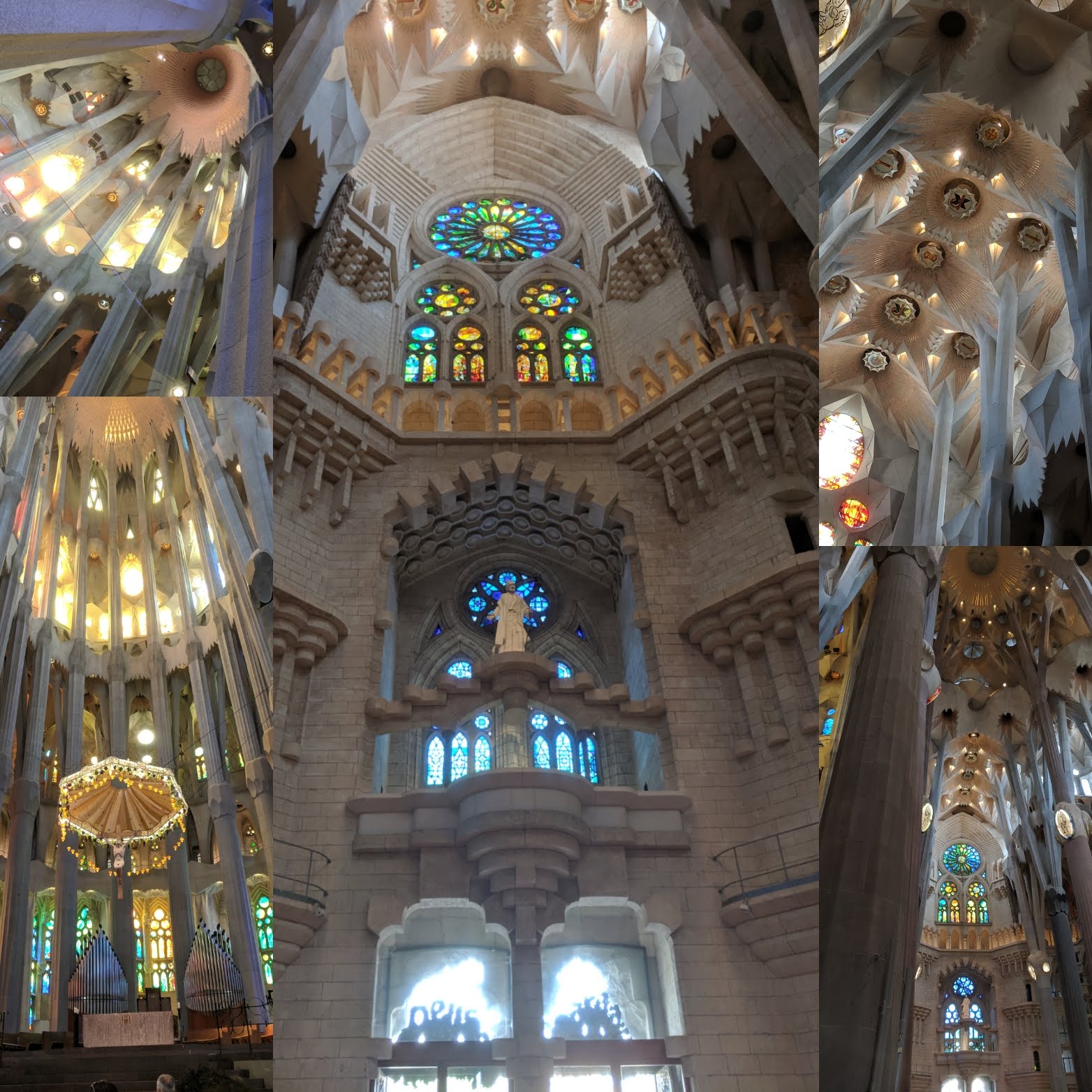
Collage of the Sagrada Familia. June 2018


I struggle to write about the Sagrada Familia; not only because there are no words that can do it justice but because the mere attempt to verbalize the experience feels hollow. No poet could adequately describe it. No photograph can hope to capture its essence. Not even video can recreate the magic of walking into a church truly unlike any other.
Three Photospheres taken at the Sagrada Familia. One exterior (the Paradise facade) and two inside.

Our trip last year to Italy was a tour of food and God. We visited more churches in three weeks than I had visited over the course of my whole life prior. I had meticulously packed clothing with sleeves. I had mapped out the locations of some of my favorite pieces of art. So often in Italy, I was drawn to a church not for the space but for the art it contained. It was like a special type of museum. The Sagrada Familia does not feel like any of those at all.
Sagrada Familia: Sculptures from the Passion of the Christ Facade. June 2018
The overarching vision is credited to one man but the execution has evolved over the 130+ years it has been under construction. It still will not be completed for another decade or two (the tentative completion date is 2026, on the 100 year Anniversary of Gaudi’s death but likely finishing touches will take another decade or so). This is a church on the scale and grandeur to rival any in Italy but it has all been constructed in recent memory. Its history shaped by the Spanish Civil War, two world wars and advancements in engineering and technology. The artists and craftsman working on it are still alive and producing. The technology used to produce it has evolved, where Gaudi would sketch and then build models aspects in plaster, today they design with computers and 3D print their models.
Sagrada Familia: Current construction and active workshop June 2018

  I still intimately remember seeing the Sagrada Familia during our last trip to Barcelona in 2011. We woke up early to get tickets for the day and were some of the first people inside that morning. It was a weekday in September, overcast and we had much of the grounds to ourselves. When I first walked into main chamber, I started to cry. Thinking back on that moment now, I find myself fighting tears. It was the most beautiful creation I had ever seen.  

Visiting this time was very different. Security had been increased. It was difficult to purchase tickets on the day of entry and it was substantially more crowded. The location of the entrance had changed from when we last visited as one façade had been completed and construction is now occurring on what will become the main door. Parts that were being worked on in 2011 had since been completed and other areas were closed. The ubiquity of smart phones and proliferation of selfies had transformed the space into a massive photo booth. And yet, it is still one of the most beautiful places I have ever seen.
Sagrada Familia: Collage of Interior Shots. June 2018

The cavernous interior is lined with columns (none straight) each gently curving in parabolas and hyperbolic arches that branch upward like trees in a canopy. Each column is unique in terms of type of stone, shape, adornment and branching. 

The space is bathed in light, the walls covered in stained glass windows with deep saturated colors towards the ground that get ever fainter as they approach the heavens. Unlike most stained glass which attempts to use the colored panes to depict an image, these windows only serve to exhibit form and function. There are no saints personified or stories told. There is only a simplistic beauty that radiates out from the walls.
Sagrada Familia: Collage of Interior Shots. June 2018

Spiral staircases curl along the four interior towers each imbued in a single color like the four stones in the Fifth Element. Just standing within the massive color-filled space feels like being inside of a kaleidoscope. As the sun moves through the sky, the interior transforms and the space feels completely different after even an hour.
Sagrada Familia: Collage of Interior Shots including Spiral Staircase Top Right.

In 2011, our visit lasted much of a day as our ticket included the main cathedral, the towers, cloisters and crypt. This trip we opted just for the main cathedral and museum which meant we finished our early afternoon visit right around tapas o clock. In Spain, breakfast is an espresso and pastry. Lunch is served only between 1:30-3pm and is the primary meal of the day. Tapas which are small bites and snacks typically enjoyed with drinks (much like happy hour) is between 5-6:30pm. Dinner, typically which is usually a light affair is served between 8:30-10pm. Eating outside of these windows generally results in having street food/snacks or diner cuisine.

From the Sagrada Familia we walked a few blocks to El Petit Porquet, a small brightly lit café that specializes in charcuterie. We shared a board with a variety of freshly sliced cured meats including Jamon Iberico. This tender flavorful ham comes from wild pigs whose entire diet consists of acorns), chorizo, salami, and cured pork tenderloin. We enjoyed these mouthwatering meats with traditional Catalan bread which is slightly toasted bread smeared with tomato, olive oil and salt. And of course there was vermouth.
Collage of Images from El Petit Porquet
The Quest

With 9pm dinner reservations at Restaurant Montiel, the first tasting menu Sean and I enjoyed together the night we got engaged we had several hours to hunt for the location of our impromptu betrothal. We tore Barcelona city map out of the Lonely Planet Spain book and set about defining the scope of our search. In 2011 we stayed at the NH hotel, we marked it on the map. That afternoon we had gone to the Picasso museum (marked) went back to the hotel before we set out to get drinks before dinner at Montiel (marked). We were able to narrow the search to the El Born neighborhood, a rectangular area about 1000 m by 600 m. Our goal was to find a small corner store with outdoor seating (our collective memory suggested it had a wooden deck which was quite unusual in Spain). This small corner shop was located in a small square a few streets off from a much larger square with many restaurants. I had a very good memory for the path we took from the big square to the small one. So if we could find the big square, we could find the place we got engaged.

Map in hand, we set out among the winding streets of Barcelona. There was an excitement, an electricity in the air. Whether we found it or not, the act of looking was exciting. On our way from the Gothic Quarter to the El Born neighborhood we stopped briefly at an unusual shop that sold only rubber duckies. I took this as a sign.

When Sean and I first moved in together, my little sister came to visit us and hid dozens (at least 50) tiny rubber duckies all over our apartment. Even years later we would open a random cabinet and find one. When we moved, I meticulously gathered them all and they now live collectively in a vase in our game room. In honor of this whimsical tradition of rubber duckies, our wedding cake was adorned with a large bride and groom rubber ducky. Now as we prepared to search for the place where we got engaged, there was a rubber ducky store. I turned to Sean and said “I think we’re going to find the spot.” I also went inside and bought a rubber ducky decorated like a Gaudi lizard in honor of Barcelona, it only seemed right.

Rubber ducky in hand, we continued across the city until we reached the Northern boundary we had drawn on the map. We cross off street by street marking tiny Xs on our paper map as we used our phone GPS to track our location. When we came upon the modernist Catalan concert hall Petit Palau, an unusual red and green building surrounded by modern art we were certain we had not traveled this far North in 2011. We made note of the building as something worth checking out in the future and then redrew the boundaries shrinking the area by a few hundred meters. We set off again, determined and meticulous. Systematically going through the area like an underwater rover mapping an uncharted sea bed (or searching unsuccessfully for the missing Malaysian Airlines flight). The area looked a lot different than we remembered it. While this area has always been a notably eclectic and a cultural hub, there had been significant gentrification over the last 7 years. It was a lot more polished and some streets had succumb to a more hipster aesthetic compared to its former unconventional flare. Maybe it was naïve to think we could find it given how much things in our own city had changed in 7 years. If the business that was there had been transformed into something else, would we recognize it? We weren’t sure.

We came upon one of the handful of squares depicted on the paper map. It was modest smaller than our collective memory of the “big square” but similar enough that we marked the map with a question mark. If this was the “big square” then the small square would be nearby. We walked down each of the side streets that lead out from the bigger square but none of this looked familiar to me. There was a smaller square but it looked nothing like my memory. That couldn’t have been the big square.

By now we had been walking over an hour. We were no longer confident we could recognize the big square much less the smaller one that contained our spot. Our memories of that evening different in terms of which details we remembered. I had a very clear memory of our path from the big square to the little square. I had a clear memory of what the big square looked like. But the small square and even the shop itself was hazy. We both agreed there was a wooden deck (which was unique) but we hadn’t seen a single wooden deck this trip. Sean was very certain our spot was in a smaller square but I didn’t remember it being a square at all.

Looking across from our question-mark big square, I saw another street in the distance, larger with motorcycles driving through. I had a memory of motorcycle parking and the street along the square having traffic. Maybe it was over there. When we crossed the street we entered into a square. This was the big square! It had to be. It was on the correct side of the busier street, it had motorcycle parking, and it was the right size. I could feel my heart beat quicken as I turned around to orient myself and confidently declare that we needed to walk down two blocks and turn left. Sean’s memory of the directions were not that good but my mental map was clear. 7 years ago, hot, and thirty it felt like we were on a quest. I remember walking around and searching in futility for a place to get a drink and sit down that wouldn’t expect you to order a meal. With it being dinner time and a busy Saturday night, it was difficult to find a place that met those specifications. We walked down the two blocks and there was a yellow arrow on the side of the building pointing left. “See Sean, it knows where we are supposed to go.”

We walked down to the left half a block and the buildings parted into a small square. Sean was right. It was in a square. Kids played soccer in the dirt square. Two old men sat on a bench talking. We looked around and declared this was it. On the corner was an ice cream shop whose interior was pristine and suggested it had been recently renovated. There were tables in the courtyard but no wooden deck. Still, this had to be it. The business next door, a corner shop was closed. But we were at least 90% certain this was it. We dropped a pin on google map to mark the location. We took a selfie on the corner much to confusion of the locals. Another yellow arrow marked overhead.

We were a few doors down from Montiel. Neither of us remembered it being that close but when we walked around we decided that after we got engaged we walked around and came to the restaurant from the other side which would make it feel a few blocks away enough though it was on the same block.

A lot has changed in seven years. I asked Sean if he had planned to propose while on the Barcelona trip in 2011 and he said he didn’t have a plan. He knew he wanted to get married soon and making it official just happened. Because there was no formal proposal or ring, I had always downplayed that moment in our relationship. Only through the experience of being happily married, learning and growing from/with your partner have I come to look fondly on the start of that chapter. Like so many stories in history, the mythology developed long after the act itself. It felt good finding the location. The mutual desire to go look for it, a testament of how much we love each other and how much that moment, one of many had come to shape us. We found the location using the same set of skills we had in deciding to get married: excitement, compromise, communication, teamwork and a lot of luck.
Select images from our Quest! Bottom Left: Map of our search of the El Born Area (as much as Google could easily track via my phone).  Top Middle: The Rubber Ducky  Top Right: Our Wedding Cake 11/11/11. Bottom Right: The spot.

Up Next Our Meal at Montiel (Recent Recipient of a Michelin Plate!)